AIR Lab Featured in Global Airspace Radar: APAC Collaboration Progresses
8 October 2026
The October 2026 issue of Global Airspace Radar explores the initiatives connecting Asia-Pacific's 40-plus ANSPs, featuring AIR Lab and its Regional Collaboration Platform as a free, open-access sandbox for ATM innovation.
AIR Lab is featured in Issue 4 of Global Airspace Radar magazine (October 2026), in “APAC collaboration progresses”, a feature by aviation journalist Emma Kelly on the initiatives bringing together a region with more than 40 air navigation service providers (ANSPs), varied airspace users and booming air traffic.
Read the full feature in Global Airspace Radar, Issue 4 →
From simulation to the skies
The article presents AIR Lab, the joint innovation laboratory established by the Civil Aviation Authority of Singapore (CAAS) and Thales, and its Regional Collaboration Platform (RCP): a free, open-access, cloud-based sandbox designed to allow ANSPs, airlines, researchers and start-ups to collaborate on ATM innovation.
“The platform is primarily used to test and trial new operational concepts. This includes observing, understanding, analysing and simulating scenarios to explore how new procedures or technologies could work in practice. A key use case is assessing how aviation infrastructure and the systems that support it will be able to cope with the significant air traffic growth expected across the region.”
— Jean-Philippe Mota, Director, AIR Lab
The RCP is currently used by seven ANSPs in the region, and AIR Lab has been working with two ANSPs to ensure the FF-ICE module embedded in the RCP can connect to SWIM and be used during Pathfinder trials.
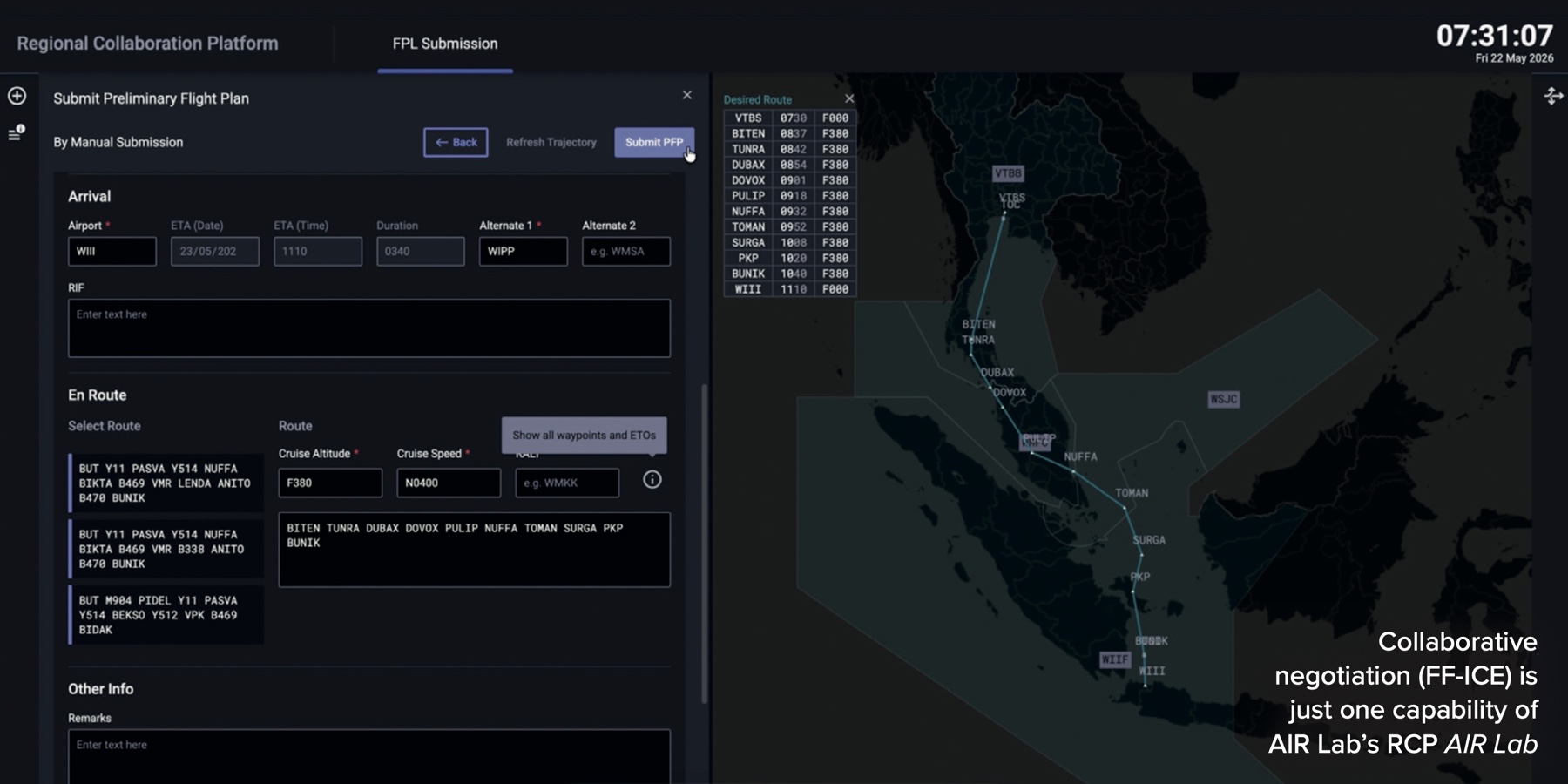
The feature highlights the RCP’s key capabilities:
- Collaborative negotiation (FF-ICE): automated trajectory negotiation between airlines and ANSPs, with the full exchange visible in real time to both sides.
- Air Situational Display: global surveillance data from multiple sources combined into a comprehensive regional air traffic picture.
- Fast-time simulation: a full day of traffic simulated in seconds using accurate operational data, to run scenarios and anticipate potential disruptions.
As the article concludes, only through such collaborative initiatives will the Asia-Pacific region be able to cope with what lies ahead.